Gothic Kitchen Decor That Survives a Working Kitchen
How to do a dark kitchen in a room with heat, grease and daily wear — what carries the look, what fails, which changes a renter can undo, and where it tips into Halloween.
The kitchen is usually the last room a dark interior reaches, and the one where it most often goes wrong. Every other room can be styled. A kitchen has to be cooked in, wiped down, and lit well enough to handle a knife safely, and decor that ignores any of those three gets removed within a season. The pieces that survive are the ones that were built to be used and happen to be black — a dish set, hardware, storage, textiles — with novelty limited to one or two accents that can be picked up and moved.
Start with the things you touch every day
The single change that shifts a kitchen furthest is the dish set, because it appears on the counter, in the sink, on the table, and behind glass cabinet doors. It is the only decor in the room that keeps moving back into view. A matte or reactive-glaze stoneware set in a deep tone does more work than a wall full of ornaments, and it does it without ever reading as a theme.
Flatware is the same logic on a smaller scale. Matte black flatware is coated stainless rather than solid metal, so the finish is the part that wears. The coating lasts far longer with hand washing than it does through repeated dishwasher cycles at high heat, which is worth knowing before you buy rather than after the first set goes patchy.
Cabinet hardware is the cheapest structural-looking change in the room. Swapping handles and pulls for matte black changes the read of every cabinet face at once, takes a screwdriver, and the original hardware goes into a bag for the day you move out.
Matte black is a fingerprint magnet, and that is a real decision
Matte black finishes on faucets, hardware and appliances show water spots, oils and dust in a way that gloss and stainless steel do not. In a bathroom that is a minor annoyance. In a kitchen, where hands are wet and greasy several times a day, it is a daily wipe-down you are signing up for.
There are two ways around it without giving up the colour. Satin or brushed black hides marks considerably better than a true flat matte, and textured or hammered surfaces break up the reflection so spotting never gets a clean field to show on. If you want flat matte anyway, put it on the things you touch least, such as a range hood, upper cabinet pulls, or open shelf brackets, and keep the faucet and the fridge handle in a finish that forgives.
Open shelving is where the aesthetic actually lives
Closed cabinets hide everything you own, which means a kitchen with no open storage gives the aesthetic almost nowhere to appear except the walls, and kitchen walls are mostly taken already. One open shelf, one glass-front cabinet, or a rail changes that immediately, because now the contents are the decor.
The rule that keeps it from looking cluttered is the same one that governs a gallery wall: hold the palette, vary the shape. Amber and cobalt glass, dark ceramic, brass or matte black metal, and one clear material repeated. Jars of the same family in different sizes read as a collection. Jars of five different families read as a cupboard someone forgot to close.
A wall-mounted magnetic knife holder does the most work in this category, because it is genuinely better storage than a drawer. Blades kept apart from each other keep their edges, and taking the block off the counter buys back the scarcest surface in the room. Countertop blocks are the alternative when drilling into the wall is not an option.

Novelty is an accent, and it has a low ceiling
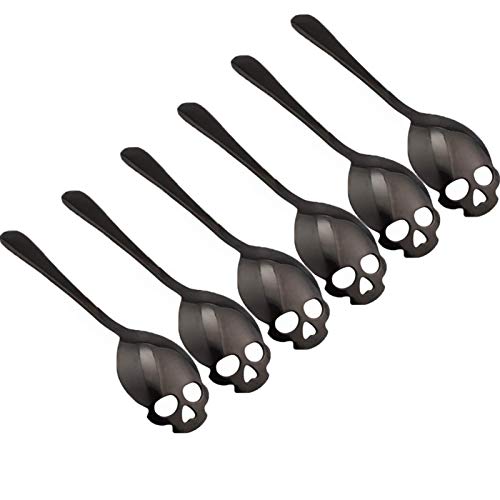
Skull-handled spoons, a carved mug, a planter with a face. These work, and they work precisely because there are two of them. The failure mode of a gothic kitchen is not restraint, it is accumulation: every individual novelty piece is fine, and thirty of them is a seasonal aisle.
A useful test before adding another one is whether the piece could sit in the room with the theme removed. A good black mug is a good mug. A resin skull with a hollow back is an ornament that has to earn its shelf space against everything else competing for it. Buy the first kind repeatedly and the second kind rarely.
The other reason to keep novelty at accent level is practical. Much of it is resin or coated composite, which makes it decor rather than tableware, and a kitchen full of things that cannot touch food is a kitchen with less usable surface than it started with.


A dark kitchen needs more task light, not less
This is the part people skip and then quietly resent the room for. Dark cabinet faces, dark counters and dark walls absorb light instead of bouncing it, so the same fixture that lit a white kitchen adequately will leave a dark one dim exactly where you are holding a knife. The fix is task lighting under the upper cabinets aimed at the work surface, not a brighter ceiling fixture, which mostly lights the tops of your cabinets.
Warm colour temperature keeps the mood without costing visibility. The instinct to go dim, which serves every other room in a dark interior, is the one instinct that does not transfer to a kitchen.
Open flame is the other thing that does not transfer. Candles belong on the dining side of the room and nowhere near a cooktop, loose sleeves, or a run of paper towel. The general placement rules apply here with less margin than anywhere else in the house.
Four changes a renter can undo completely
Cabinet hardware, as above: unscrew, replace, keep the originals. Textiles, meaning a dark runner, tea towels and a window treatment, which change the colour temperature of the whole room and go into a box when you leave. Dishes, glassware and flatware, which were never attached to the building in the first place.
And freestanding storage instead of fixed shelving. A narrow bookcase, a bar cart, or a small cabinet gives you the open-storage surface the aesthetic needs without a single hole in a wall you do not own. If you do want a magnetic knife holder up, strong adhesive mounting versions exist specifically for this problem.
Where it tips into Halloween
The line is material and function. A cast iron pot rack, dark stoneware, amber glass and aged brass are permanent objects that happen to suit a dark palette. Plastic bones, cobweb stretch, anything orange, and any print of a cartoon ghost are seasonal props, and the room reads as undecorated the moment the season passes.
The test this site keeps returning to applies here as clearly as anywhere: would this still look deliberate on the first of November? A kitchen passes that test more easily than most rooms, because nearly everything in it already has a job. Let the jobs carry the aesthetic and the room stays yours all year.
Common questions
Do black cabinets make a small kitchen look smaller?
They make it look enclosed rather than smaller, and whether that reads as cosy or cramped depends almost entirely on light. A small kitchen with a window and good under-cabinet task lighting handles dark cabinetry well. One with a single ceiling fixture and no natural light will feel like a corridor. If light is limited, put the dark on the lower cabinets and keep the uppers light, which holds most of the effect and loses most of the problem.
Is matte black hardware hard to keep clean?
It shows water spots and finger oils more than any other common finish, and in a kitchen that means wiping it down as part of normal cleaning rather than occasionally. Satin or brushed black hides marks noticeably better than flat matte, and textured or hammered surfaces hide them best.
Can I use a resin skull as a kitchen container?
Not for anything that touches food. Resin is not food-contact rated and is not heat stable, so it works as an ornament, a crock for clean utensils, or a planter with a liner dropped into it. It is not a canister for anything you intend to eat.
What single change has the biggest effect?
The dish set, for the simple reason that it is the only decor in a kitchen that keeps reappearing, on the counter, in the sink, on the table and behind glass. Cabinet hardware is a close second and is the cheapest structural-looking change in the room.
How do I keep a gothic kitchen from looking like Halloween?
Weight it toward objects that have a job. Dark stoneware, cast iron, amber and cobalt glass, aged brass and matte black hardware are permanent materials. Plastic bones, cobweb stretch and anything orange are seasonal props. Keep novelty to one or two accents and the room stays year-round.