Your dimensions in — the cut list, the six miter angles, and a full-size gauge to print. Because the angles are not thirty degrees, and no miter box has them.
A coffin outline is an irregular hexagon, so its six joints carry three different angles. Plans that tell you to cut everything at thirty degrees are describing a regular hexagon, which is a very different shape.
Depth is how far the shelf stands off the wall — the width of the rim pieces. Around an inch for a trinket shelf, three to four for one that holds books or a pillar candle. Width wants to land between two-fifths and four-fifths of the length; ready-made shelves sit near half, which is where this starts.
Edge lengths outside each side, miter angle at each corner. Head at the top.
Cut list
Head — cut 1
5.00 in (5)
Miter 33.7° at one end, 33.7° at the other. Both ends the same, mirrored.
Shoulder — cut 2
6.50 in (6 1/2)
Miter 33.7° at one end, 17.4° at the other.
Body — cut 2
14.32 in (14 5/16)
Miter 17.4° at one end, 39.0° at the other.
Foot — cut 1
4.00 in (4)
Miter 39.0° at one end, 39.0° at the other. Both ends the same, mirrored.
Rim stock to buy
63 in of 3 1/2 in wide stock
The six pieces come to 50.6 inches; the rest is the offcut waste angled ends generate, plus room for one ruined cut.
Back panel
10 × 20 in
Cut the panel oversize, glue the frame to it, then trim flush once it is dry. Cutting it to the outline first means every small frame error shows as a gap.
Every length above is the long point — measured along the outside edge, corner to corner. The inside edge of each piece is shorter, and measuring there is the single most common way these come out too small.
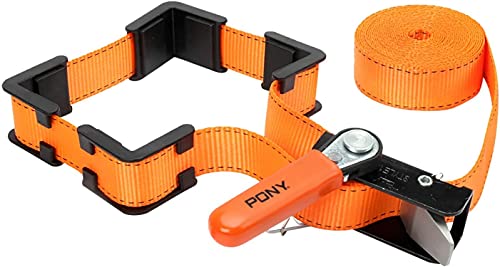
Cut all six, then dry-fit with a strap before any glue. Error accumulates around a closed frame: six joints each off by half a degree leave a three degree gap at the last one, and there is nowhere for it to go.
Print the gauges
No hand miter box offers these angles, and no powered saw has a detent at them. The gauges below are drawn at full size — print this page, cut them out, and use them to mark and check every cut. Set a powered saw with an angle finder instead.
This bar must measure exactly four inches. If it does not, reprint at 100% scale — "fit to page" is the usual culprit, and it will quietly shrink every gauge below.
To use: cut out each gauge. Lay its long bottom edge along the outside edge of your piece, with the corner at the end of the cut. Scribe the sloped edge, cut a little proud of the line, then sand back to it. Every length below is measured on the outside edge, long point to long point.
Piece
Qty
Length (outside)
Miter at ends
Head
1
5 in
33.7° / 33.7°
Shoulder
2
6 1/2 in
33.7° / 17.4°
Body
2
14 5/16 in
17.4° / 39.0°
Foot
1
4 in
39.0° / 39.0°
Back panel
1
10 × 20 in, cut oversize and trimmed flush after glue-up
What to build it from
At this depth it is a carcass rather than a frame, so it wants panel stock that can hold a screw and a back that braces it against racking.
Baltic birch plywood, 1/2 in
Void-free B/BB core in craft panel sizes. Half-inch is the sensible floor for a shelf that carries anything.
Once it is built, hanging it is its own problem — the leverage on a shelf that stands off the wall is covered in hanging a coffin shelf, and what it can safely carry in coffin shelf weight. For the dimensions the ready-made ones come in, see coffin shelf sizes.